

Technology is transforming the race to save nature, by drastically cutting the time it takes to identify specimens, a report has found.
AI models have been able to identify the correct place in the “Tree of Life” for millions of plants and fungi, some with only microscopic distinguishing features. As well as “triaging” those most at risk for botanists to prioritise, the models also generate opportunities for potential medicine to be researched, as well as speeding up the search for climate-resilient wild relatives of key food plants such as coffee, or identifying alternatives to meat.
A global study using AI to analyse eight million digitised plant specimens dating back a century revealed flowering has shifted by 2.5 days earlier or later every decade on average, disrupting relationships between plants and pollinators.
It is just one of the ways in which converting preserved specimens of plants and fungi that lie “hidden in cupboards and boxes” into digital records is transforming the fight to save life on Earth, said experts at the Royal Botanic Gardens, Kew.
In the Canadian Arctic, meanwhile, plant flowering season is shrinking, which could have consequences on a global scale.
Action needed
Kew’s State of the World’s Plants and Fungi report says digital tools have exposed critical gaps in scientific knowledge and highlighted where action is most needed.
The concern is that species could become extinct faster than they can be documented. More than 12,000 species were named as new to science in 2024 and 2025, including a parasitic fungus found in Brazil erupting from a trapdoor spider that it had infected and consumed. An estimated 100,000 plants and two million fungi species are still to be discovered.
Kew’s executive director of science Alexandre Antonelli said the latest discoveries were “just scratching the surface” and many of the newly described species are threatened with extinction “from day one”.
But Kew’s sixth plant and fungi report has a hopeful message, focusing on the power of AI, digitisation and other technology to boost knowledge and conservation efforts around the world. It also highlighted the potential to do more with co-ordinated international action.
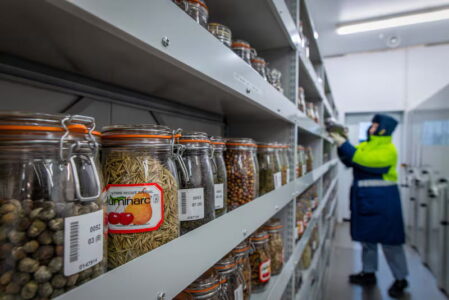
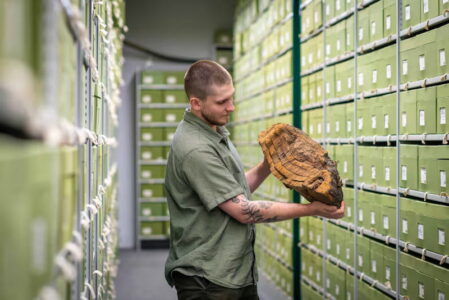
The move to scan Kew’s 7.4 million-strong herbarium and fungarium collection of pressed plant leaves, flowers, seedheads, mushrooms and spores – samples that date back centuries – was the biggest investment in a single scientific project in the centre’s 267-year history. Many of the specimens in its collection originated from the Middle East, including Saudi Arabia, Oman and Iraq.
The scheme, funded by the UK’s Department for Environment Food and Rural Affairs, opened every cupboard and box in the herbarium to scan the specimen sheets at 40 imaging stations. The project involved digitally recording up to 20,000 images a day, while bigger species such as palms had to removed from their boxes and carefully recorded.
The meticulousness of early botanists – measuring, colouring and illustrating their discoveries – was perfect for AI models to operate on, even if deciphering Victorian handwriting was sometimes an issue. Digitisation is also uncovering the hidden contributions of overlooked collectors, including First World War soldiers who found plants on the front lines, as well as indigenous communities.
Landy Rajaovelona, senior botanist at Kew Madagascar, said many of the country’s species remained “undocumented, understudied and increasingly at risk” despite being one of the world’s most extraordinary biodiversity hotspots.
“We are taking active steps towards assessing extinction risks, effective conservation and training the next generation of Malagasy scientists,”
In Costa Rica, researchers increased the country’s known fungal diversity by 20 per cent by combining published records with digital collections.
For the first time, scientists are unlocking the “dark matter of fungi”, producing high quality genomes from past fungal specimens, including samples up to 180 years old. The experts said the ability to unlock the secrets of known species of fungi – which make up less than 10 per cent of the estimated species in the world – could lead to new uses, such as high-protein alternatives to meat. Plastic-digesting fungi could also help to tackle pollution.
Priorities
The report warns that, without reliable data on what species exist, where they occur globally and the effects of climate change, conservation efforts may overlook the most vulnerable species. Opportunities to develop new medicine or sustainable crops may also be lost.
“For centuries, scientists worldwide have pressed, dried and labelled plants and fungi collected from every corner of the Earth, inaccessible to most. Until now,” the report said. “Thanks to technological developments, millions of preserved specimens are being digitised and analysed at unprecedented scale, allowing researchers to compare material remotely, correct misidentified species and uncover previously hidden biodiversity.”
Nearly 30,000 species of plants and more than 410 species of fungi are threatened with extinction, as defined by the International Union for Conservation of Nature. But only a fraction of known species have been assessed – 18 per cent of plants and 0.6 per cent of fungi.
Scientists suffer an “agony of choice” in deciding which specimens to focus on and AI can help them to prioritise the most likely candidates for extinction, said Steve Bachman, research leader of species conservation at Kew.
He told The National it has taken more than 20 years of work to get to this stage, with scientists able to identify one or two species in a day, but that AI could transform the process. There are limits, however, as AI needs to be trained on examples and inevitably there are fewer examples of rare plants found by botanists “off-piste”.
Prof Antonelli said there had been an “explosion of data” created in a “biodiversity revolution” as millions of specimens were photographed and digitised.
He said until now scientists wishing to study many specimens from their own countries needed to visit Kew to search its collections. The digital archive has made them more accessible.
Prof Antonelli hoped the “next pandemic medicine” could be found within the specimens that had been digitised and would otherwise have taken years to uncover.
Blind spots
The report warned there are major gaps in global biodiversity data which limits global action. “Fewer than 16 per cent of the world’s herbarium specimens have currently been imaged and made available digitally, leaving huge blind spots in our understanding,” it said. “The gaps are particularly pronounced in parts of the Global South … meaning conservation decisions are being made using incomplete or biased information.”
It found that in Honduras, 33 per cent of the total species recorded from protected areas were missing from conservation management plans, while countries such as Nigeria remain largely invisible to global biodiversity science.
Mr Bachman said there had been significant efforts in the Middle East to improve its cataloguing of nature, but there was still a lot of work to do to catch up with Europe and North America.
Paul Leitman, reflora co-ordination assistant at the Rio de Janeiro Botanical Garden, said: “Not only have these resources highlighted where gaps in collections exist, such as in the Amazon rainforest, but digitising some of the smaller, local collections has revealed species new to science that were entirely absent form larger collections.”