

Europe’s air quality is getting better, despite “persistent pollution episodes” threatening to halt progress.
The EU’s Copernicus Atmosphere Monitoring Service (CAMS) says in its latest report that while some parts of the continent are still experiencing issues with local air pollution the overall outlook “remains encouraging”.
The Assessment Report on European Air Quality 2025 details air quality trends and information on the main pollutants regulated by the Ambient Air Quality Directive, which aims to align the EU’s air quality standards more closely with recommendations of the World Health Organisation (WHO).
What’s driving Europe’s cleaner air?
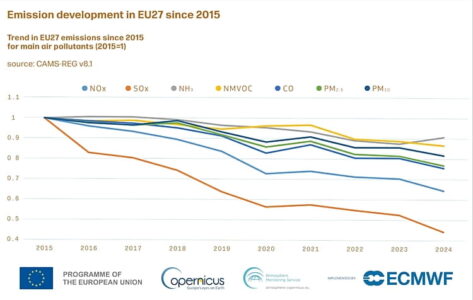
Since 2015, emissions of sulphur oxides (SOx) and nitrogen oxides (NOx) have fallen by approximately three to five per cent per year across the EU, with the most significant reductions in industry and road transport.
Transport is the only sector still producing more emissions than it did in 1990, lagging behind industry, electricity generation, and buildings, as it generates around a third of EU pollution. But it is falling. Europe’s transport sector emitted 1.05 billion tonnes of CO2 in 2024 – down from 1.1 billion tonnes in 2019, meaning a 5 per cent drop. The uptake of electric vehicles is largely responsible for this, having risen steeply over the last few years, replacing petrol and diesel powered alternatives.
The transition from fossil fuels to clean energy sources is also contributing to improvements in air pollution. More than half of net electricity generated in the EU came from renewable sources in the second quarter of 2025 for the first time ever. Last year, Sweden generated a staggering 99 per cent of its electricity from low-carbon sources, the highest of any EU country.
Which gases are the worst sources of air pollution?
Sulphur oxide is a highly toxic gas released by burning fossil fuels. It can severely irritate the respiratory system and contributes to fine particle pollution – which can drive acid rain formation.
Nitrogen oxide has a similar impact on human health, threatening to inflame the airways and reduce lung function. Even short-term exposure can trigger asthma attacks and coughing.
NOx is also categorised as a potent greenhouse gas, meaning it traps heat in the atmosphere, helping to drive up global temperatures.
According to CAMS, industrial emissions of SOx have fallen by 59 per cent, while NOx emissions from industry have dropped by 39 per cent. Road transport emissions have also fallen substantially, with reductions of 40 per cent for NOx and 34 per cent for PM2.5.
“Europe continues to make steady progress in improving air quality thanks to sustained efforts to reduce emissions from transport, industry, residential heating, and other key sectors,” says CAMS Director Laurence Rouil.
Can extreme weather impact air quality?
As parts of Europe remain gripped by a deadly heatwave, experts warn that high temperatures, intense sunlight and “stagnant atmospheric conditions” create favourable conditions for ozone formation during the summer period.
While ozone in the stratosphere acts as a shield to protect Earth’s surface from the sun’s harmful radiation, near the surface where we live and breathe, ozone is a harmful pollutant that can cause damage to lung tissue and plants.
Ozone forms when sunlight initiates chemical reactions in the air involving pollutants, particularly nitrogen oxides.
The report found that elevated concentrations of ozone were recorded during Europe’s series of heatwaves that scorched the continent in June and August last year.
Prolonged dry conditions can also contribute to severe wildfire activity, which can have a huge impact on air quality.
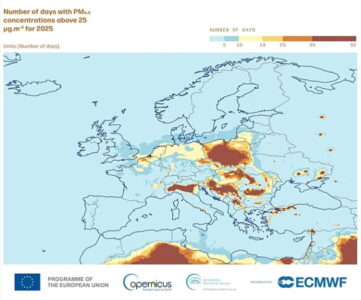
Record wildfires that burned between 11 and 19 August last summer “heavily impacted Portugal and Spain, and led to widespread exceedances of daily PM2.5 limit values across parts of the Iberian Peninsula”, the report warns.
“The wildfires in August 2025 showed how closely these hazardous events are connected to air quality,” says the report’s author Paul Hamer.
“In addition to elevating the levels of particulate matter at the surface level, the fire plumes also contributed to the increase in surface ozone levels in northern Portugal and Spain, because of the release of a significant amount of ozone precursors which react in sunlight as the smoke travels.”