

Changes in architecture could allow UAE residents to spend up to eight months of the year feeling comfortable while outside, an expert said.
Kishore Varanasi, director of urban design at US-based CBT Architects, says elements such as green walls, channels that create breezes and shading will help to reduce heating effects.
While in the hottest months being outside for long periods is difficult regardless of the design of outdoor spaces, he said work to reduce heating could extend the period people spend outdoors by a month or two each year.
“It’s really unbearable for three or four months,” he said of UAE temperatures. “For six months, it’s not that bad. And there are a couple of shorter months [that could be made comfortable].
While periods such as late September and early October, and late April and early May, might be considered too hot and humid, Mr Varanasi believes these “shoulder” periods can be made more comfortable.
“Should we take a different approach and focus on the eight months – late September, October to March, April, early May? If we reset the design methodology we can increase the outdoor months. That was one thing we’ve focused on – thinking about the time of use,” he said.
Mr Varanasi used this design approach when creating several outdoor spaces for the Abu Dhabi Climate Resilience Initiative several years ago.
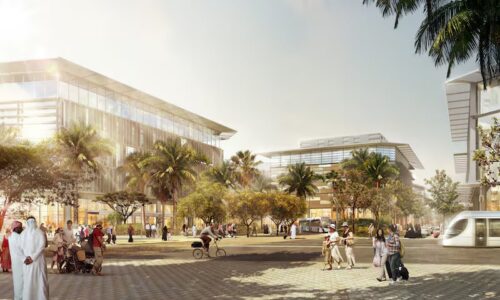
He describes the use of shading as “low-hanging fruit” but said there are approaches other than simply installing sunshade, which can sometimes result in heat being trapped. “We realised that was only protecting in the middle of the day, when the sun is pretty much on your head,” he said.
“[People] are likely to be out before work and again in the evening, when the sun angle is much lower. We felt we needed to recalibrate the design during the day. The sun moves around. We’re beginning to think about the time and the angle of shading. We came up with more vertical shading rather than horizontal.”
In the shade
Mr Varanasi said it any shade should ideally be mobile so it does not have to be in place for 24 hours a day.
“A shade that sits on a space has a danger of trapping heat over time,” he said. “One of the things we’ve done with the shade was, in the case of plazas, to have the shade disappear at night, to expose the night sky.”
CBT Architects, based in Boston, Massachusetts, has for more than a decade carried out planning and design work for Masdar City and in places such as Al Hudayriyat Island, where sports, leisure and residential projects are being developed. The company has also undertaken work for the Department of Municipalities and Transport in Abu Dhabi.
One of CBT Architects’ flagship schemes in the country involves the Abu Dhabi Climate Resilience Initiative, for which the firm created a mosque plaza, an intersection and a small park.
These projects, which have all been completed, offer what the company has previously described as “a new paradigm for public space design for all places that face urban heat issues”.
Aiming to create “cool spots, paths, walls and canopies”, they could make users comfortable even during warmer months – albeit not at the height of summer – and at “shoulder” periods of the day outside of the hottest hours. The schemes made the finals of the World Architecture News Awards in 2022.
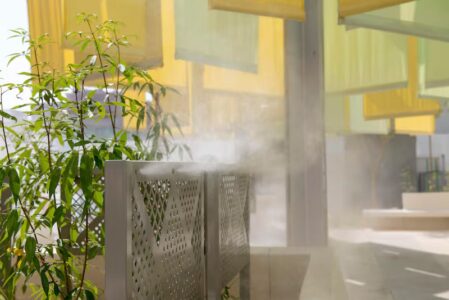
CBT Architects has also been involved with in an urban forestry project in Riyadh. As well as having shade to limit solar radiation, Mr Varanasi said that outdoor spaces should be designed to maximise airflow.
Wind of change
Mr Varanasi, a senior principal at CBT Architects, has taken inspiration from the traditional Arabian Sikka – narrow alleyways between structures.
“They’re close to buildings that provide shade but channel the winds,” said Mr Varanasi, who was born and raised in India before he moved to the US.
He also said low walls could reduce the heating effect from nearby roads. “Green walls”, planted with vegetation, can also be effective at reducing heating.
To minimise outdoor heating, Mr Varanasi suggests a four-pronged approach. This consists of vertical shading, green walls (which also channel air), native vegetation and reflective materials. “If you’re using just one [of these measures], you’re not going to get the comfort that you need,” he said.
Native vegetation can create microclimates cooler than surrounding areas, demonstrated by numerous academic studies. Their shading effect reduces temperatures, while the process of evapotranspiration, in which plants release water vapour, consumes energy and lowers temperatures.