

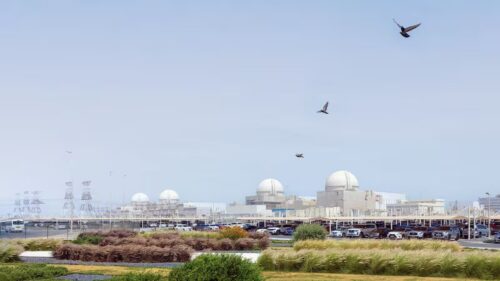
The Barakah Nuclear Energy Plant in Abu Dhabi had its first unit plugged into the national power grid on August 19, 2020.
Five years on, the plant, which is located in the Al Dhafra region of Abu Dhabi, now produces 40 terawatt hours annually – the equivalent of around 25 per cent of the UAE’s electricity needs.
That would power 574,000 households or meet the entire annual electricity needs of a country such as New Zealand, according to Peter Bryant, professor of Radiation Protection Sciences and Nuclear Energy Policy at the University of Liverpool.
“As the first nuclear station in the Arab world, it has established itself as one of the most advanced and reliable nuclear facilities globally,” he told The National.
‘A rare global success story’
In December 2009, the Emirates Nuclear Energy Corporation awarded a $20 billion contract to Korea Electric Power Corporation to construct the plant, which features four units, each powered by the state of the art APR-1400 reactor, designed to operate for 60 years.
“The design was conservative and the government didn’t dither,” said Professor Wade Allison, emeritus physicist at the University of Oxford. “It shows what’s possible with the right leadership and planning.”
Nuclear power, he argues, remains the only scalable, low-carbon solution capable of supporting a modern economy. “Nuclear is a million times more energy-dense than fossil fuels,” said Prof Allison. “[Nuclear] is the most environmentally friendly of all.”
Global nuclear energy experts say as the plant was built on time and within target, it stands as a model of nuclear efficiency in a world still grappling with energy insecurity and rising emissions. “What matters is energy resilience,” Dr Simon Bennett of The University of Leicester told The National.
A climate work horse delivering results
More critically, the plant has helped the UAE cut its annual carbon emissions by 22.4 million tonnes, the equivalent of taking nearly five million petrol cars off the road.
“Globally, Barakah has shown that an emerging economy can safely and successfully adopt nuclear energy to deliver clean, reliable power,” said Prof Bryant. “It has become a model for how nuclear can contribute to both climate action and socio-economic progress.”
The UAE’s nuclear success has recently made headlines beyond the energy world. In August 2025, aluminium smelted using Barakah’s clean electricity was exported for the first time, setting a new low-carbon benchmark for a traditionally carbon-heavy industry.
Economic dividends and Stem pipeline
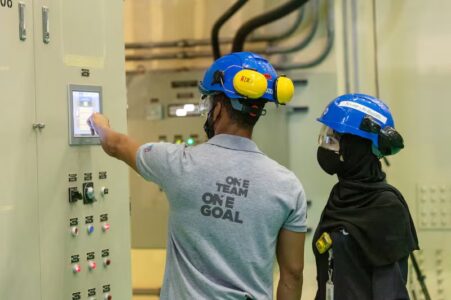
Barakah’s impact hasn’t stopped at emissions. The plant has created skilled jobs, built a new domestic nuclear supply chain, and spurred on a new generation of Emirati scientists, engineers, and technicians.
“It’s not just lighting homes,” said Prof Bryant. “It’s building human capital and driving economic diversification – a pillar of the UAE’s broader Vision 2030 strategy.”
Education and trust remain critical
For nuclear to reach its potential, experts say public education must catch up with the science. “Society developed a nuclear phobia over the past 70 years,” said Prof Allison. “But we trust nuclear in hospitals, why not in the environment?”
He believes nuclear literacy should start in schools. “From the age of 12, children should learn the basics alongside their parents. Investment follows confidence, and confidence requires knowledge.”
Dr Adam Fenech, Provost, Canadian University Dubai, agreed and said nuclear energy has long carried a “bad rap” due to historic accidents and concerns about waste management.
“These perceptions, however, often overshadow its significant contributions and evolving role in today’s energy landscape,” he said. “Modern nuclear technology is far safer, more efficient, and better regulated than in past decades, with robust safety protocols and international oversight mechanisms that have dramatically reduced risks.”
A foundation for the future
Earlier this year, the UAE’s Minister of Climate Change and Environment, Dr Amna Al Shamsi, commented that the country recognises the “transition to clean energy requires global collaboration.”
“The UAE is actively engaged in international partnerships to share knowledge, promote innovation, and support developing nations in their pursuit of sustainable energy solutions,” she said.
Barakah now plays a central role in helping the UAE meet multiple UN Sustainable Development Goals, including affordable energy, climate action, and innovation and infrastructure. It has also enhanced international co-operation: in 2025, Emirates Nuclear Energy Company signed a global expansion deal with Hyundai E&C of South Korea, exporting its expertise to other countries looking to follow suit.
“This plant has built more than electricity,” said Prof Bryant. “It’s built a community of knowledge and global credibility. And it’s proving that nuclear, when done right, can be one of the cleanest, safest and smartest energy choices we have.”
Source: https://www.thenationalnews.com/news/uae/2025/08/19/uae-barakah-nuclear-plant/